
Why Multi-Cloud Strategies Are Becoming More Important
Discover how GPCN simplifies multi-cloud management by bringing global private cloud infrastructure together through one secure platform.
Enterprises are increasingly looking to distribute their cloud operations across multiple providers to improve resiliency and redundancy. Failures in hyperscaler control planes have proven that even geographically distributed environments within a single hyperscaler may not provide true redundancy.
However, searching for providers across multiple regions, countries, and regulatory environments, while managing multiple contracts and billing cycles, can be complex and time-consuming. While public cloud platforms offer global reach, they can introduce architectural trade-offs that become increasingly problematic at scale.
Cost volatility, opaque orchestration, forced duplication, and loss of placement control can complicate a long-term multi-cloud strategy, particularly for steady-state, data-sensitive, or latency-dependent workloads.
Organizations need a simpler way to implement a resilient multi-cloud architecture without adding fragmented management tools, separate contracts, and unpredictable costs.
A Multi-Cloud Management Platform Built for Greater Control
GPCN, the Global Private Cloud Network, provides organizations with access to global private cloud infrastructure through an on-demand, consumption-based model. As a multi-cloud management platform, GPCN offers single-pane-of-glass management, consolidated billing, and no egress fees.
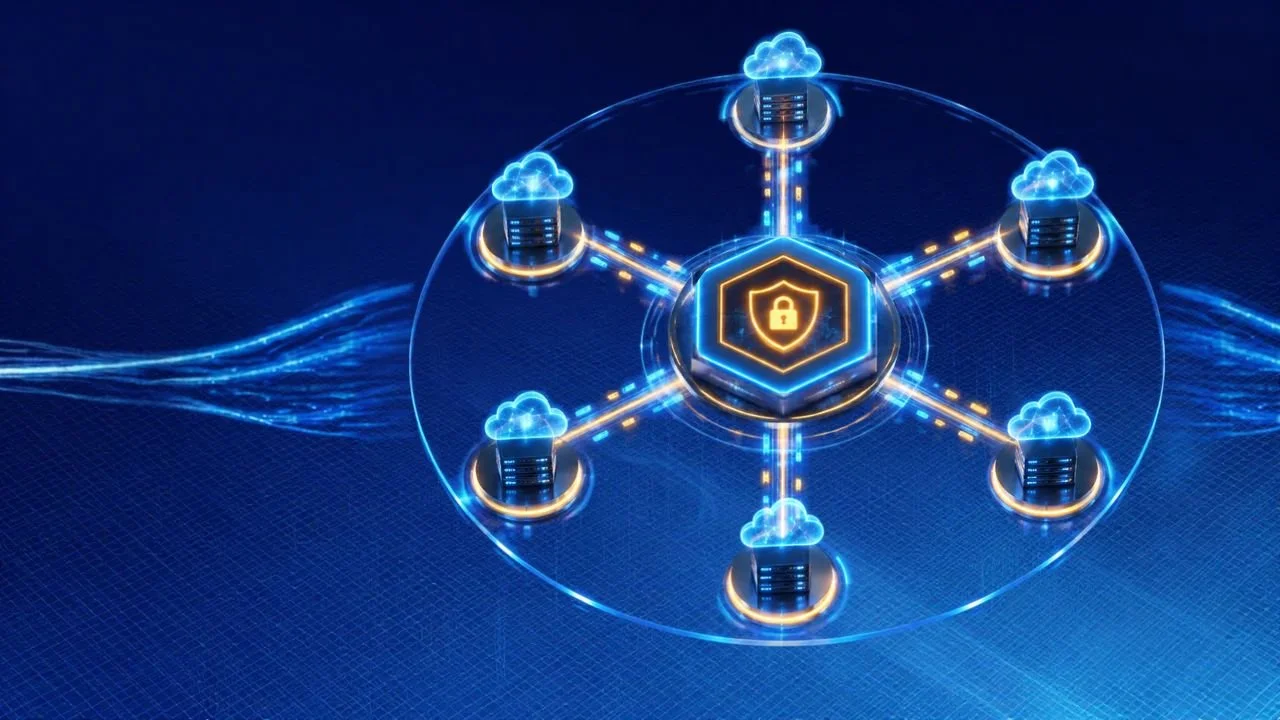
GPCN interconnects 25 and growing Tier 3 and Tier 3+ private cloud data centres worldwide, providing a consistent access and control layer without operating as a traditional cloud provider. The infrastructure remains private and purpose-built, while global reach is achieved through controlled connectivity rather than hyperscale abstraction.
GPCN provides:
On-demand provisioning
Private and dedicated CPU, GPU, and storage
Global availability
Cloud-adjacent storage for performance and data locality
No egress fees
This model helps organizations access private cloud computing services across multiple locations while maintaining greater control over workload placement, infrastructure costs, and data.
How the GPCN Architecture Works
Our maintenance partners provide comprehensive break/fix support across most hardware platforms from leading manufacturers. Our maintenance solutions cover brands such as Dell EMC, NetApp, Hitachi, IBM, Cisco, and HPE, and can include call-home monitoring on most devices when required.
Most supported platforms are either End of Sale (EoS), meaning the manufacturer no longer sells the product as new, or End of Service Life (EoSL), meaning the manufacturer no longer provides support. Our service partners help clients extend the life of their assets well beyond the manufacturer's EoSL date, supporting a more sustainable approach to IT asset lifecycle management.
Reduce Waste Through Responsible E-Waste Recycling
Users, applications, and services connect to geographically local private cloud access points over short-haul public internet paths. Once traffic enters the GPCN environment, it traverses a private, business-only service fabric that interconnects participating private cloud locations.
A centralized API and control layer standardizes provisioning, lifecycle management, and visibility across providers and regions. This approach simplifies multi-cloud management while allowing organizations to maintain control over where their workloads and data are located.
For organizations operating across countries or regulated environments, this model can also support data sovereignty solutions by providing greater visibility and control over infrastructure and data placement.
Infrastructure as Code with Terraform
In addition to direct API access, GPCN supports infrastructure-as-code workflows through an official Terraform provider. This allows customers to provision, manage, and version-control their GPCN infrastructure using declarative configuration.
Organizations can integrate private cloud resources into existing CI/CD pipelines and operational practices without sacrificing placement control or governance. This provides a consistent way to manage private cloud computing resources as part of a broader multi-cloud architecture.
Availability Without Forced Duplication
GPCN provides a 99.99% availability SLA for compute services without requiring multi-zone duplication. The SLAs are backed by Tier 3 and Tier 3+ facility guarantees and are designed to support deterministic infrastructure behaviour.
The platform maintains a clear separation between infrastructure delivery and operational tooling, allowing organizations to define governance, security, and management models aligned with their requirements.
How GG TEQ Helps
GG TEQ is proud to partner with the Global Private Cloud Network to help organizations access a global network of secure private cloud infrastructure designed for AI, data-intensive workloads, infrastructure modernization, and greater control over costs and data.
GG TEQ can assist customers with planning, architecting, and securing their deployments within the GPCN environment. Together, GG TEQ and GPCN can help organizations build a more controlled and flexible multi-cloud strategy without the complexity of managing each provider separately.
This partnership creates new opportunities for customers seeking:
Data sovereignty
AI-ready infrastructure
Greater infrastructure flexibility
Access to multiple private clouds
One portal and one bill
No egress fees
Contact GG TEQ to explore how GPCN can support your multi-cloud strategy, AI infrastructure requirements, data sovereignty goals, and infrastructure modernization plans.