
Zero Trust Network Access: The Future of Secure Remote Access
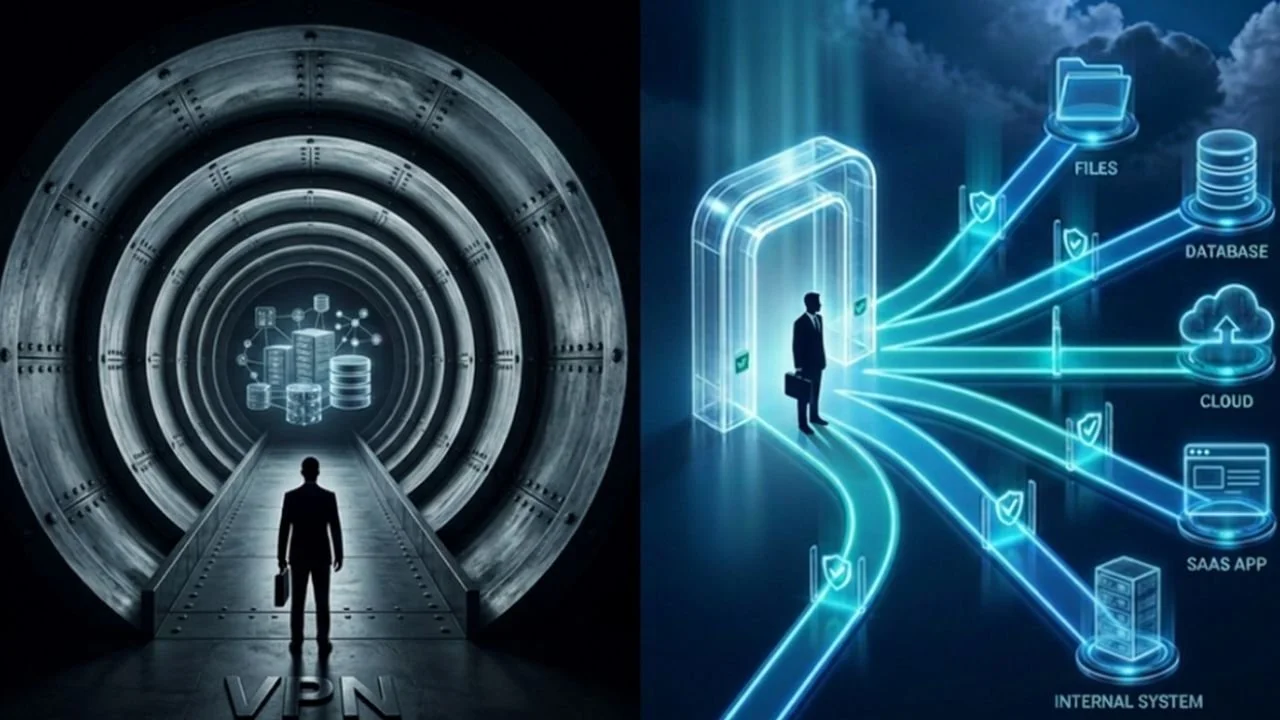
The end of VPN
How organizations are replacing legacy VPNs with Zero Trust Network Access to improve secure remote access and reduce security risk.
VPN isn’t failing because it’s outdated. It’s failing because the entire security model behind it no longer works.
As organizations rethink secure remote access, many are evaluating Zero Trust Network Access (ZTNA) as a modern secure remote access solution and a replacement for legacy VPN architectures. In today's Zero Trust world, access decisions can no longer rely on network location alone.
For decades, organizations relied on a simple assumption: If a user is inside the network, they can be trusted.
That assumption is now one of the biggest risks in enterprise security.
The collapse of the perimeter model
Legacy VPNs were built on a trust model designed for a very different world.
Once authenticated through an encrypted tunnel, users were treated as trusted simply because they were “inside” the network.
This “castle-and-moat” approach created a binary view of security:
Inside = trusted
Outside = untrusted
That model is not just outdated. It’s dangerous.
Today’s environments are distributed. Users are remote. Applications live everywhere. And attackers no longer need to break in.
They just log in.
As applications move to the cloud and workforces become increasingly distributed, organizations need remote access security solutions that provide secure remote access while continuously verifying users rather than trusting them by default.
When the front door becomes the attack path
As threats evolved, attackers stopped trying to break down the walls and started walking through the front door.
Compromised credentials allowed malicious actors to:
Access the network through VPN like legitimate users
Move laterally across flat internal environments
Escalate privileges with limited resistance
VPN didn’t just become less effective. It became the attack path.

VPN attack flow diagram.
Over the past several years, major breaches have repeatedly involved compromised credentials and exposed remote access infrastructure. Security agencies like CISA and the NSA continue to flag VPNs as a high-risk attack surface. The growth of identity-based attacks is prompting many organizations to re-evaluate their remote access policy and accelerate Zero Trust initiatives.
Exploits now move at a different speed
The bigger shift isn’t just how attacks happen. It is how fast they happen.
With automation and AI, vulnerabilities are now exploited in days, hours or even minutes once they become known, far faster than enterprises can patch their infrastructure.
The gap between exposure and response has collapsed.
If your organization relies on legacy VPN as a primary control for remote access, that gap becomes a serious liability.
Why Zero Trust Network Access (ZTNA) is replacing VPN
The successor to legacy VPN is Zero Trust Network Access (ZTNA), a modern approach to secure remote access built on continuous verification.
The principle is simple: Never trust. Always verify.
This approach forms the foundation of modern Zero Trust Security and enables organizations to deliver secure remote access without exposing internal networks.
Rather than authenticating a user once at the perimeter and granting broad network access, ZTNA evaluates every access request individually using continuous signals:
Identity
Device health
Location
Behavior
Legacy VPN vs. Zero Trust (simplified)
VPN model: Login → Full network access → Trust maintained
Zero Trust model: Request → Verify → Grant limited access → Re-verify
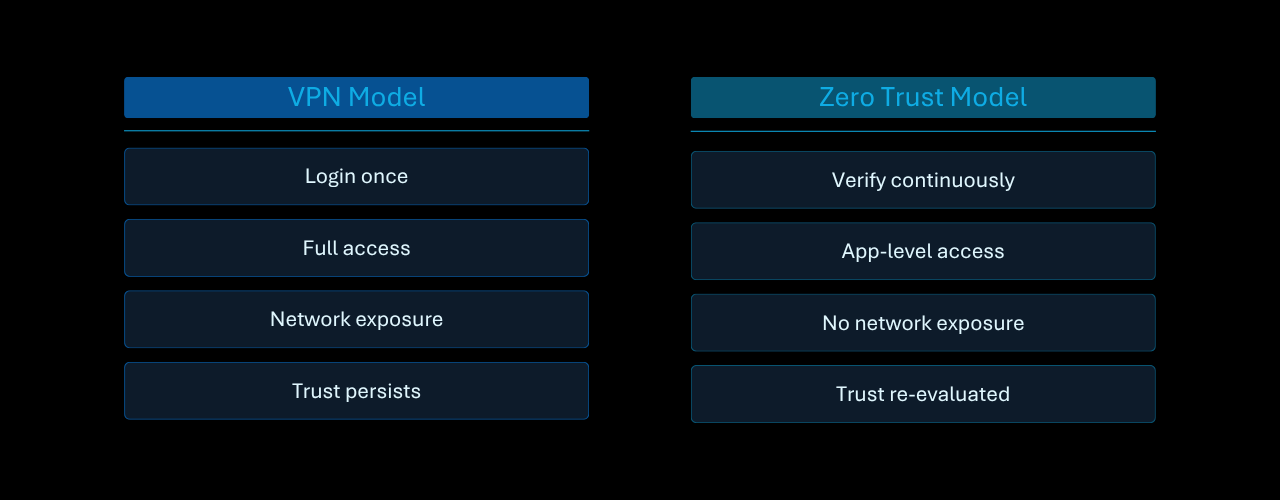
Legacy VPN vs. Zero Trust Network Access comparison chart.
From an end-user perspective, the experience is very similar.
Users run a ZTNA client or authenticate through a browser. They seamlessly connect and access the applications and services they need.
But architecturally, everything changes.
Users connect to a cloud-based security platform rather than the internal network, allowing organizations to deploy remote access security solutions that enforce access at the application level. Access is granted per application and not to the entire environment.
No exposed network
No broad lateral movement
No persistent trust
There is no “inside” to exploit.
The end of the legacy model
If VPN is so flawed, why does it still exist? Because change is difficult and often deprioritized.
Organizations face real barriers:
Existing infrastructure and sunk costs
Complex migration requirements
Edge cases (OT/ICS, legacy apps)
Internal alignment across teams
A crowded market full of “Zero Trust” rebranding
Separating real architectural change from vendor noise is increasingly difficult.
And for many, VPN remains “good enough” until it isn’t.Next steps
The end of an era
This shift isn’t about replacing one tool with another. It’s about abandoning an assumption that no longer holds: That trust can be granted based on network location.
The reality is clear:
The perimeter is gone in today’s Zero Trust world
Identity is the new control plane
Trust must be continuously earned. It is not granted once
VPN is not just aging technology. It’s a model that no longer aligns with how modern environments operate.
Organizations that continue to rely on it are carrying forward a risk that modern architectures are designed to eliminate.
What comes next
The shift away from VPN is already underway. Most organizations are somewhere in the transition.
Where are you today?
Still relying heavily on VPN
Exploring Zero Trust approaches
Actively transitioning
For organizations starting this transition, the biggest challenge is not technology. It is knowing where to begin and how to reduce risk without disrupting the business.

Zero Trust Network Access adoption journey.
If you are evaluating a move away from VPN, the first step is understanding your current exposure.
At GG TEQ, we work with organizations to assess remote access risk, evaluate your current remote access policy, and define a phased Zero Trust Network Access strategy aligned to your environment.
If you want to compare where you stand, feel free to contact us.